Computer-Guided Implant Surgery: What Changes for the Patient?
Computer-guided implant surgery uses a 3D CBCT scan and planning software to virtually place your implant before surgery, then a custom 3D-printed guide directs the drill into that exact planned position. For patients, this often means a smaller incision, shorter chair time, less swelling, and more predictable healing.
Computer-guided implant surgery uses a 3D CBCT scan and planning software to virtually place your implant before surgery, then a custom 3D-printed guide directs the drill into that exact planned position. For patients, this often means a smaller incision, shorter chair time, less swelling, and more predictable healing compared to freehand placement.
If you have been researching implants in Northwest Dallas, you have probably noticed that not every office talks about how the surgery is actually done. At Fresh Smile Dental Care on Royal Lane, we hear this question often from patients who have already decided on implants but are nervous about the procedure itself. The technique matters. So does the planning that happens before you ever sit in the chair.
Here is what changes when a surgical guide is part of the plan.
What is computer-guided dental implant surgery?
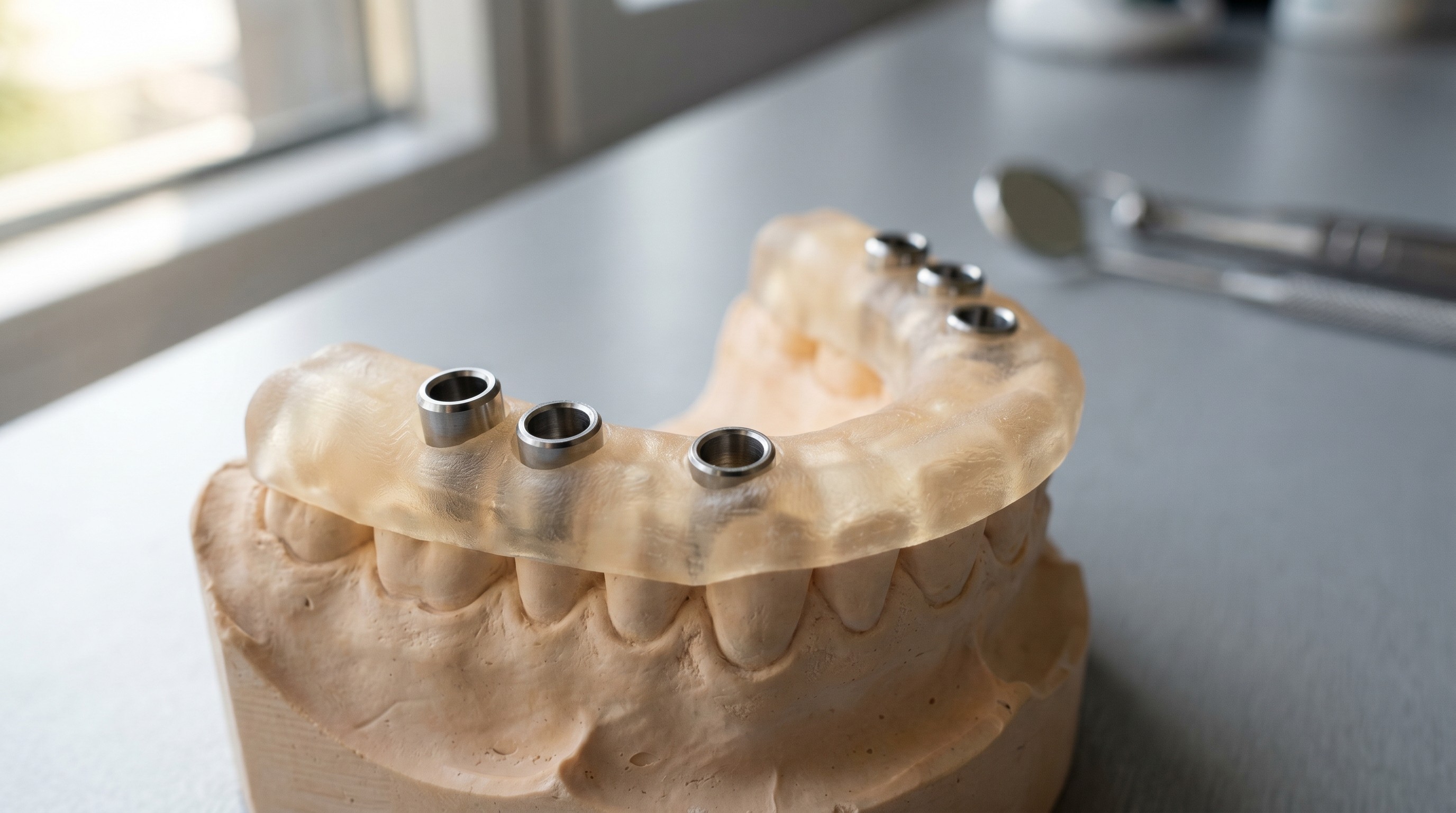
Computer-guided implant surgery is implant placement that has been planned in 3D software first and then executed through a custom surgical guide. The guide is a small, rigid template that fits over your teeth (or gums) and contains metal sleeves that direct the drill into the exact angle and depth chosen during planning.
Contrast that with freehand placement. In freehand surgery, the dentist relies on a 2D X-ray and visual judgment to estimate angle and depth in real time. Skilled surgeons can do this well. But the margin for error is wider.
Three core technologies make guided surgery possible: a cone-beam CT scanner (CBCT), implant planning software, and a 3D-printed surgical guide. According to the American Academy of Oral and Maxillofacial Radiology, CBCT is the imaging standard for 3D evaluation of bone before implant placement.
How does the planning process actually work?
The planning happens before surgery day, often days or weeks in advance. Here is the sequence we follow at our office in the Asian Trade District:
Step 1: CBCT scan. A cone-beam CT captures your bone volume, nerve canals, and sinus position in 3D. This is the map.
Step 2: Intraoral scan. A digital impression of your teeth and gums is merged with the CBCT, so the bone, soft tissue, and existing teeth all appear in one model.
Step 3: Virtual placement. Dr. Yeo places the implant inside the software, choosing the exact angle, depth, and size. The planned crown is positioned first, then the implant is placed to support it. The International Team for Implantology calls this restoratively driven planning, and it improves the final prosthetic outcome.
Step 4: 3D-printed guide. A surgical guide is printed to fit precisely over your teeth. On surgery day, the guide snaps in, and the drill follows the sleeves.
The decisions are made in software. The surgery just executes the plan.
What changes for the patient on surgery day?
This is the part patients care about most. Several things shift when a guide is used.
Often the incision is smaller, or no flap is raised at all. A flapless approach is possible when the planning confirms enough bone and healthy gum tissue at the site. Published implant literature associates flapless placement with reduced post-operative swelling and lower patient-reported discomfort.
Chair time tends to be shorter once the guide is seated. The drilling sequence is faster because the angle has already been decided. Less time in the chair. Less fatigue for everyone.
Risk of hitting the inferior alveolar nerve or perforating the sinus floor drops significantly. The guide physically prevents the drill from straying outside the planned path.
That is the whole trick.
Is guided surgery safer than freehand placement?
Systematic reviews published in Clinical Oral Implants Research and the Journal of Clinical Periodontology show that static computer-aided implant surgery produces smaller mean deviations from the planned position than freehand placement. Both angular accuracy (how off the tilt is) and coronal accuracy (how off the entry point is) improve.
What does that mean in plain English? The implant ends up where it was planned to go. More predictably. Every single time the guide fits properly.
There is a caveat. The European Association for Osseointegration notes that guide accuracy depends on several factors: how the guide is supported (tooth, gum, or bone), the quality of the CBCT scan, the stability of the guide during drilling, and the operator's experience. A guide does not replace surgical judgment. It sharpens it.
This is one reason Dr. Yeo's background matters here. He has served as a live-surgery implant instructor for DIO Implant in 2016 and Hiossen in 2019, teaching other dentists how to combine guided workflows with sound clinical decision-making.
Who benefits most from a guided approach?
Not every implant case requires a guide, but several scenarios benefit clearly:
Limited bone. When the bone is thin or short, the margin for error is small, and the guide protects against drift.
Implants near major anatomy. Sites close to the sinus floor or the mandibular nerve are safer when the drill path is constrained.
Full-arch cases. Multiple implants must be parallel to each other to support a fixed bridge. Guides keep them aligned.
Same-day extraction-and-implant cases. The guide preserves the planned position even after the tooth is removed and the socket geometry changes.
Anxious patients. A shorter, more predictable appointment lowers the stress of the unknown.
A working professional from Preston Hollow recently came in for a single implant near the upper sinus. She had been told elsewhere that her bone was borderline. With CBCT-based planning, we mapped a path that avoided the sinus and confirmed she would not need a sinus lift. The actual surgery took less than 45 minutes.
What does guided implant surgery look like at our Koreatown Dallas office?
Fresh Smile Dental Care sits on Royal Lane between Harry Hines Boulevard and Marsh Lane, inside the 1.6-mile Koreatown Dallas corridor that Texas officially designated in 2023. Every implant case at our office is planned in 3D software before any surgical step.
Patients come in from Farmers Branch, Preston Hollow, Addison, and across Northwest Dallas 75229. The DART Green Line Royal Lane Station is two blocks from our door, which makes the commute simple even for patients who prefer not to drive after a sedation appointment.
Consultations are available in English, Korean, and Spanish. Implant planning is one of those conversations where being able to ask questions in your first language genuinely matters.
Frequently Asked Questions
Does computer-guided implant surgery hurt less than traditional surgery?
Most patients report less post-operative discomfort, especially when a flapless approach is used. Smaller incisions and less tissue manipulation generally translate to less swelling and bruising. The local anesthesia during surgery is the same, so the procedure itself feels similar in the moment.
How long does a guided implant procedure take?
A single-implant guided placement often takes 30 to 60 minutes of actual surgical time once the guide is seated. The planning happens beforehand, so chair time on surgery day is typically shorter than a fully freehand workflow. Full-arch cases take longer but are still more efficient than placing each implant freehand.
Is guided implant surgery more expensive?
There is added cost for the CBCT scan, planning software time, and fabrication of the custom guide. At our practice, this is usually included in the overall implant fee rather than charged as a separate line item. The added precision often saves money long-term by reducing the risk of failure or revision.
Can every implant case be done with a surgical guide?Most cases can, but not all. Patients with very limited mouth opening, certain large existing restorations, or specific anatomy may need a hybrid or freehand approach. Dr. Yeo evaluates each case during the planning phase and recommends the technique that fits the situation.
How accurate is a 3D-printed surgical guide?
Systematic reviews report that static guided surgery typically achieves placement within about 1 to 2 mm of the planned position at the implant tip, with angular deviations of just a few degrees. Tooth-supported guides tend to be the most accurate. Operator technique and guide stability during drilling remain important factors.
Ready to plan your implant the precise way?
If you are considering dental implants and want to understand how guided planning could change your specific case, we would be glad to walk you through it. Call Fresh Smile Dental Care at (214) 623-0880 to schedule a consultation with Dr. Yeo. Our office on Royal Lane is open Monday, Tuesday, Thursday, and Friday from 9:00 AM to 5:00 PM.
Recommendations