Why Does My Breath Smell Even After Flossing and Brushing?
If your breath still smells after brushing and flossing, the source is usually bacteria on the back of your tongue, dry mouth from medications or sleep, hidden gum pockets, tonsil stones, or sinus drainage. Brushing cleans tooth surfaces but misses these deeper sources, so the odor persists until the real cause is treated.
If your breath still smells after brushing and flossing, the source is usually bacteria on the back of your tongue, dry mouth from medications or sleep, hidden gum pockets, tonsil stones, or sinus drainage. Brushing cleans tooth surfaces but misses these deeper sources, so the odor persists until the real cause is treated.
At Fresh Smile Dental Care on Royal Lane, we hear this weekly from patients who do everything right. They brush twice. They floss. They still cover their mouth in meetings. A software engineer who commutes from Farmers Branch down I-635 recently told Dr. Yeo she had switched toothpastes three times in a month and nothing helped. Her hygiene wasn't the problem. Her tongue was.
That distinction matters. Once you know hygiene isn't the failure point, you can stop scrubbing harder and start looking in the right place.
Why does breath still smell after a thorough clean?
Brushing and flossing clean the surfaces of your teeth and the spaces between them. That's it. They don't touch the back of your tongue, the tonsil crypts in your throat, the sinuses draining into the back of your mouth, or the deep gum pockets that form when tissue pulls away from the tooth root.
According to literature published in the Journal of the American Dental Association, the majority of halitosis cases originate from bacteria on the dorsum of the tongue that produce volatile sulfur compounds. These compounds smell like rotten eggs or sour milk. Mint toothpaste masks them for about an hour. Then they come right back.
Roughly 85 to 90 percent of bad breath cases have an oral cause, based on reviews in the Journal of Clinical Periodontology. The remaining 10 to 15 percent trace to ENT, respiratory, or systemic sources. That's a big clue. Most of the time, the answer is still inside your mouth. Just not on your teeth.
Is my tongue the real source of the smell?
Probably yes. The back third of your tongue is textured with tiny crypts that trap food particles, dead cells, and anaerobic bacteria. Those bacteria break down proteins and release the sulfur compounds that create odor.
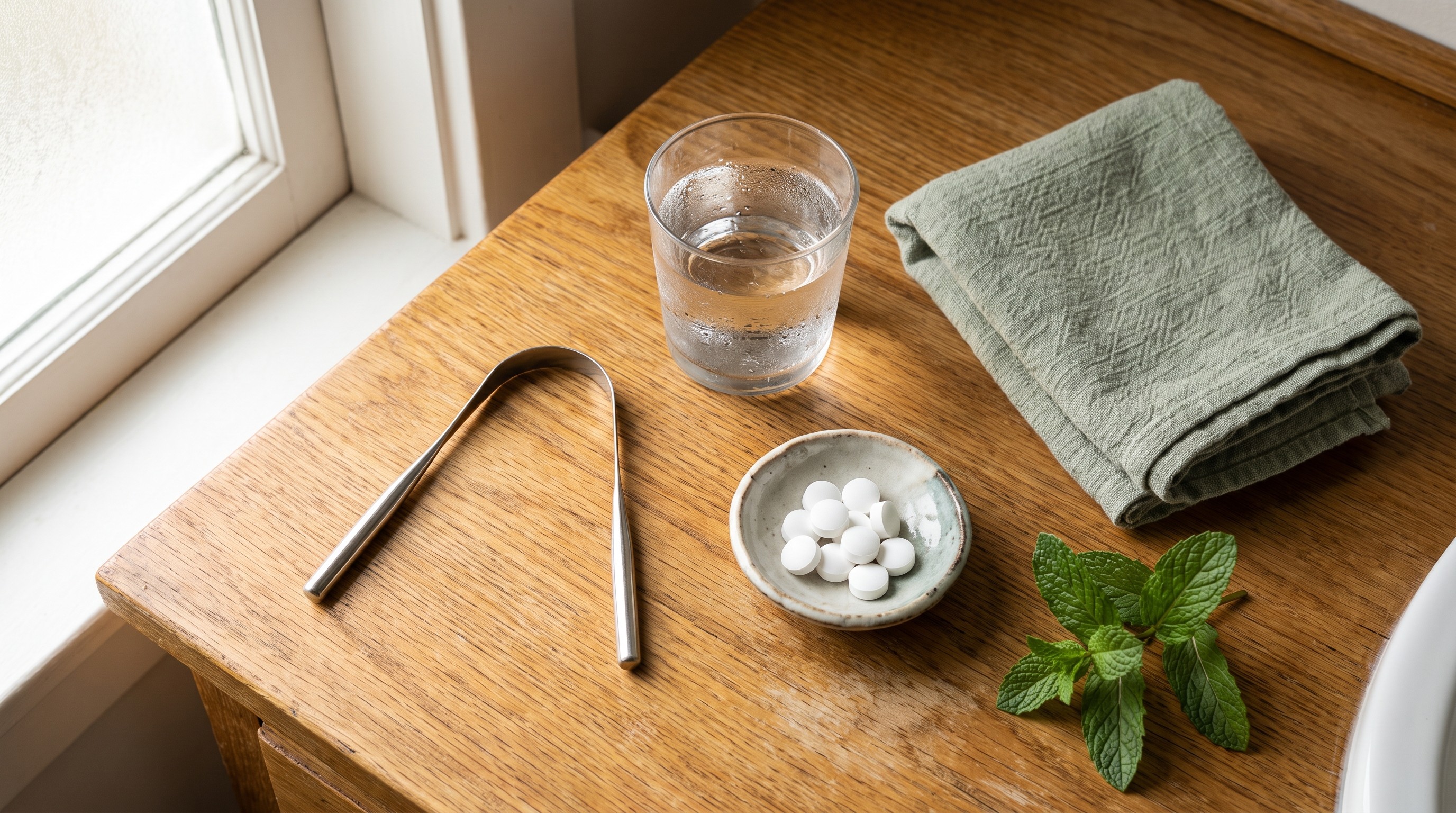
Look in the mirror and stick out your tongue. A white, yellow, or gray coating on the back is a visible sign of bacterial buildup. Toothbrush bristles don't remove it well. A dedicated tongue scraper does.
Use it correctly:
Reach as far back as you comfortably can without gagging
Drag from back to front in one smooth motion
Rinse the scraper, then repeat 4 to 6 times
Do this once a day, ideally in the morning
Many patients pick up stainless-steel scrapers at H Mart or Komart in the Asian Trade District right down the street. Any drugstore version works too. That's the whole trick.
Could dry mouth be causing my bad breath?
Saliva is your mouth's rinse cycle. When it slows, bacteria multiply and odor builds. The NIDCR notes that saliva flow drops naturally during sleep, which is why morning breath happens even to healthy people.
The bigger issue is daytime dry mouth, called xerostomia. Common culprits include:
Antihistamines for allergies (Dallas cedar season is brutal on this)
Antidepressants and anti-anxiety medications
Blood pressure medications
Mouth breathing, especially during sleep
Coffee, alcohol, and simple dehydration
The NIDCR lists antihistamines, antidepressants, and antihypertensives among the medication classes most likely to reduce saliva and contribute to halitosis. If you take any of these and notice persistent breath odor, that's your lead.
Simple fixes help. Sip water through the day. Chew sugar-free xylitol gum after meals. Breathe through your nose. Cut back on late-afternoon coffee. Small changes. Real difference.
What about tonsil stones and sinus drainage?
If you've ever coughed up a small, white, foul-smelling pebble, that was a tonsil stone. Tonsilloliths form when debris calcifies inside the crypts of your tonsils. They smell strongly of sulfur and can produce persistent bad breath even when the rest of your mouth is spotless.
Chronic sinusitis and post-nasal drip cause the same problem from a different direction. Mucus loaded with bacteria drains down the back of your throat all day. You swallow it without noticing. The odor lingers.
If Dr. Yeo examines your mouth and finds no dental source, an ENT referral is the next logical step. We work with several Northwest Dallas specialists and can point you to one.
Can gum disease still be hiding despite good habits?
Yes. This surprises people. You can floss perfectly and still have periodontal pockets that trap bacteria below the gumline where floss cannot reach.
The American Academy of Periodontology confirms that periodontal disease increases volatile sulfur compound production because of subgingival anaerobic bacteria. If your gums bleed when you floss, that's not just a hygiene note. It's a warning sign.
Professional scaling and root planing cleans below the gumline in a way home care physically cannot. One deep cleaning often resolves breath issues that months of extra brushing never fixed. Simple as that.
When should I see a dentist about persistent breath odor?
If your breath has smelled off for more than two or three weeks despite good hygiene, come in. That's the threshold where guessing stops helping.
At an exam for halitosis, Dr. Yeo checks:
Gum pocket depths around every tooth
Tongue coating and texture
Cavities, especially between teeth and under old fillings
Cracked or leaking restorations that trap bacteria
Signs of dry mouth and medication effects
Tonsil appearance and throat health
Exams are available in Korean, Spanish, and English. Many of our patients are professionals from the Dallas Koreatown corridor and Northwest Dallas who commute in via I-635 or the Dallas North Tollway. We keep visits efficient. In and out on your lunch break. No lectures.
Once you know hygiene isn't the failure point, you can stop scrubbing harder and start looking in the right place.
Frequently Asked Questions
Can stomach problems cause bad breath?
Sometimes, but less often than people assume. Acid reflux (GERD) can push stomach contents into the back of the throat and create odor. H. pylori infections have also been linked to halitosis in some studies. That said, roughly 85 to 90 percent of bad breath is oral in origin, so we always rule out the mouth first before sending patients to a gastroenterologist.
Does mouthwash actually fix bad breath or just mask it?
Most drugstore mouthwashes mask odor with mint and alcohol for 30 to 60 minutes. Some alcohol-based rinses actually worsen dry mouth over time, which makes odor worse in the long run. Look for alcohol-free rinses with chlorhexidine, cetylpyridinium chloride, or zinc compounds, which target the bacteria producing sulfur compounds rather than covering them up.
How can I tell if my own breath smells?
You adapt to your own scent, so smelling your own breath is unreliable. Try this instead: lick the inside of your wrist, wait 10 seconds, and smell it. That's a rough approximation of your breath. A more accurate test is asking a trusted family member or friend directly. Awkward, yes. Useful, absolutely.
Are tongue scrapers better than brushing the tongue?Yes. Studies comparing the two consistently show scrapers remove more volatile sulfur compounds than toothbrushes. Brushes push bacteria around; scrapers physically lift the coating off. If you only add one habit after reading this, make it a tongue scraper.
Can bad breath be a sign of a cavity I don't feel yet?
It can. Cavities between teeth or under old fillings often go unnoticed because they don't hurt until they reach the nerve. Food and bacteria collect inside them and produce odor. This is one of the things Dr. Yeo checks with digital X-rays during a halitosis exam.
Ready to find the real cause?
If your breath has been bothering you despite good habits, call Fresh Smile Dental Care at (214) 623-0880 or book online through Zocdoc. We're at 1894 Royal Ln #104 in Dallas, open Monday, Tuesday, Thursday, and Friday from 9 AM to 5 PM. Exams in Korean, Spanish, and English.
Recommendations