¿Puedo colocarme un implante dental el mismo día de la extracción?
Sí, en muchos casos se puede colocar un implante dental el mismo día de la extracción del diente. Esto se conoce como colocación inmediata de implantes. Para realizarlo, se requiere tener hueso sano alrededor del alveolo dental, no tener una infección activa y gozar de buena salud en general. Una tomografía computarizada 3D (CBCT) y una planificación guiada nos permitirán determinar si este procedimiento en una sola visita es seguro para usted.
Yes, in many cases, a dental implant can be placed the same day a tooth is extracted. This is known as immediate placement. The ideal candidate has healthy bone surrounding the socket, no active infection, and stable general health. A 3D CBCT scan and guided planning will tell us if a single-visit procedure is safe or if a staged protocol is better.
At Fresh Smile Dental Care, located on Royal Lane in the heart of Koreatown Dallas, we hear this question almost every week. When someone knows a tooth cannot be saved, the next thing they ask is how long they will have to go without it. The short answer: sometimes, not at all. The honest answer requires a few more details.
What Does a Same-Day Implant Actually Mean?
Immediate placement is exactly what it sounds like. We extract the tooth and, during the very same appointment, place the titanium implant into the newly emptied socket. According to the American Academy of Implant Dentistry, this protocol is formally called immediate implant placement.
It is helpful to clarify three terms that often get confused:
Immediate placement: The implant is placed on the same day as the extraction.
Immediate loading: A visible temporary crown is also placed on that same day.
Delayed placement: The socket heals first (typically 3 to 6 months), and then the implant is placed.
Most same-day cases receive the implant immediately, but the final crown is placed weeks later, after the bone has fused to the titanium. We call this process osseointegration, and according to educational materials from the ADA and NIDCR, it takes between 3 and 6 months.
Who Is a Candidate for an Immediate Implant?
Not everyone is a candidate, and it is important to be clear about that. During your consultation, we evaluate several factors before promising a single-visit procedure:
Sufficient bone volume in the socket walls.
Absence of active infection or abscess in the area.
Healthy gums and adequate gingival biotype.
Stable systemic health, including controlled diabetes and, preferably, being a non-smoker.
Single-rooted, front teeth are usually simpler candidates than molars.
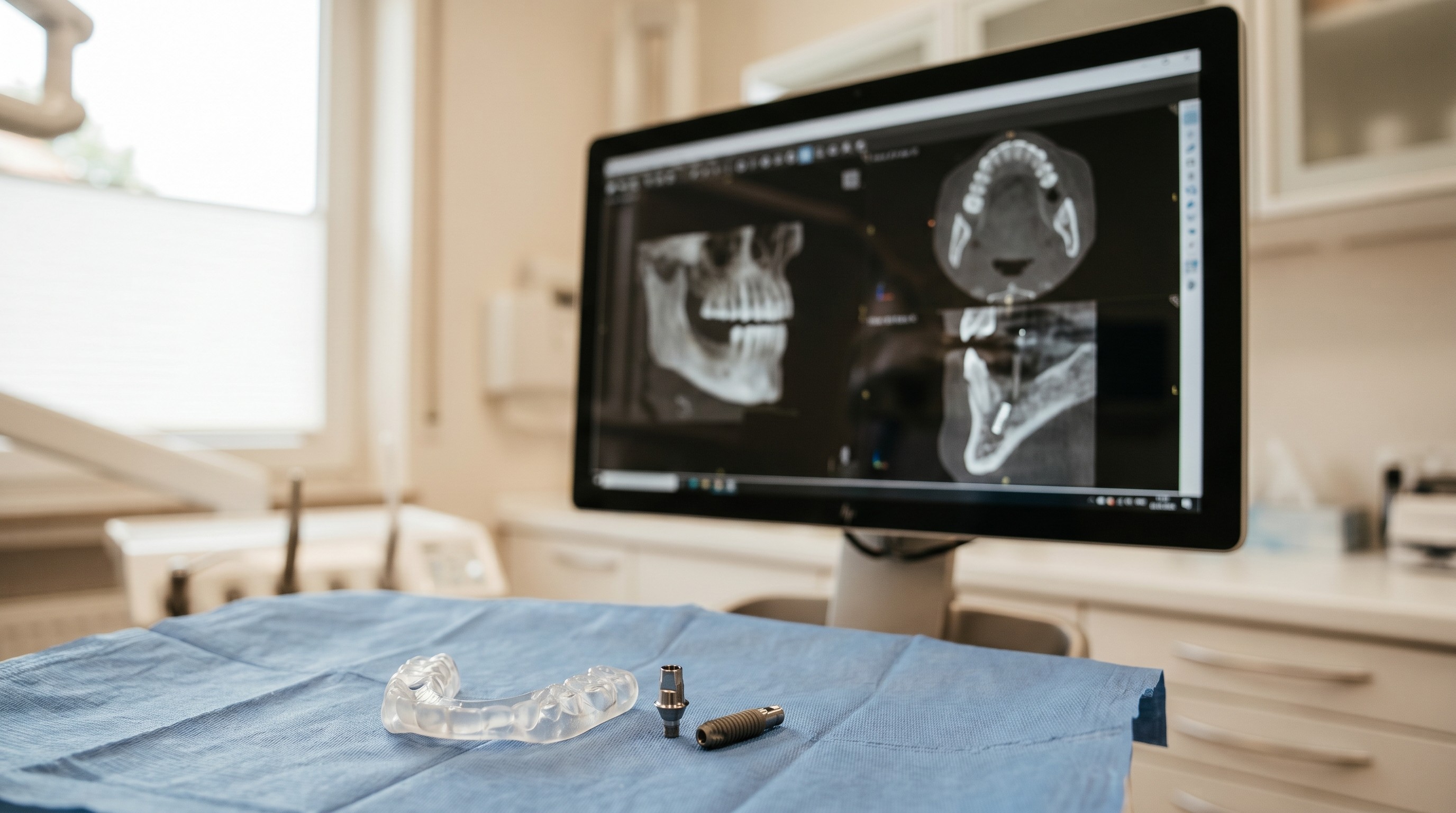
Before committing to a same-day procedure, we perform a CBCT scan. The American Academy of Oral and Maxillofacial Radiology recommends this type of 3D imaging to evaluate bone volume and anatomical structures, such as the maxillary sinus or the inferior alveolar nerve. Without this information, planning an immediate implant is just guessing. And we do not guess.
When Is It Safer to Wait Between Extraction and Implant?
There are situations where forcing a same-day placement compromises the long-term result. We move quickly when we can, and we wait when we must.
Active infection or an abscess at the tooth site. Literature in the Journal of Oral and Maxillofacial Surgery considers this a clear risk factor.
Significant bone loss that requires a bone graft before we can even consider placing the implant.
A thin gingival biotype where front-tooth aesthetics could be compromised.
Heavy smokers or uncontrolled medical conditions. A Cochrane review associates smoking with higher rates of complications and implant failure.
In these cases, the typical path is an extraction and bone graft first, followed by the implant 3 to 6 months later. It is slower, yes, but it is also much more predictable.
What Is the Same-Day Procedure Like?
Here is a real example. Recently, an engineer in his mid-40s who works in the Asian Trade District—just a few blocks from our office—came to see us. An upper molar had fractured underneath an old crown. He arrived during his lunch break, walking over from the Royal Lane DART Green Line station, expecting bad news. His scan showed intact bone walls and no active infection. We were able to confidently plan for a same-day procedure.
The typical workflow looks like this:
CBCT scan and surgical planning prior to the appointment.
Atraumatic extraction to preserve the socket walls.
Placement of the implant in the planned position using a surgical guide.
Placement of bone grafting material around the implant to fill any gaps, a practice supported by the International Journal of Oral & Maxillofacial Implants.
Placement of a healing abutment or a temporary crown, depending on the case.
The visit takes between one and two hours—almost always quicker than patients expect.
How Does Computer-Guided Surgery Change the Decision?
This is where Dr. Kwangjae Yeo's workflow makes all the difference. 3D planning maps out the exact position of the implant before we ever touch the patient. A printed surgical guide then translates that plan directly to the operatory. This reduces time in the chair and improves precision.
In immediate cases, where margins are narrow and there are no second chances to correct an angle, that level of precision changes everything. We plan it on the screen, execute it in the mouth, and avoid any surprises.
Recovery and What to Expect Afterward
The first week is the most sensitive. We recommend the following:
A soft diet for 1 to 2 weeks.
Avoiding chewing on the side of the implant until instructed otherwise.
Careful hygiene around the surgical site.
Follow-up appointments to monitor healing.
Osseointegration progresses quietly over 3 to 6 months. After that, the final, permanent crown is placed. That is when the process is complete, not before.
We serve patients coming from Addison, Carrollton, Farmers Branch, and Preston Hollow. Our team speaks English, Korean, and Spanish, with our assistant Jesús supporting our Spanish-speaking consultations. If distance or language was holding you back, we have removed those barriers.
We move quickly when we can. We wait when we must. The patient's biology decides, not the clock.
Frequently Asked Questions
Does a same-day implant last as long as one placed using a delayed approach?
In well-selected candidates, yes. What defines the lifespan of an implant is osseointegration, the patient's oral hygiene, and their bite—not whether the extraction happened on the same day or three months prior. Strict patient selection is the key. That is why we do not offer immediate placement when the scan data does not support it.
Will I leave the office with a visible tooth that day?
It depends. If we plan for immediate loading with a temporary crown, yes—this is especially common for front teeth for aesthetic reasons. For back molars, we often place only a healing abutment because it is not visible and it is safer to protect the integration of the implant. We will discuss this during your treatment planning.
How much more does an immediate implant cost compared to a delayed one?
The total cost is usually similar because it involves the same components: the implant, abutment, and crown. The difference lies in how many visits are required and whether a bone graft is necessary. In some cases, an immediate implant can actually be more cost-effective because it avoids a separate socket preservation procedure. We will provide an exact price range after your scan.
Can you place an immediate implant in a molar?
It is possible, but it is more demanding. Molars have multiple roots, meaning the resulting socket is larger and more irregular, which makes achieving primary stability more difficult. It can be done using guided planning and, almost always, with bone grafting to fill the gaps. Not all molars qualify.
What happens if you plan a same-day implant but find an infection during the extraction?
We adjust the plan on the spot. If we perform the extraction and find an infection that was not clearly visible on the scan, we clean the site, place a bone graft if indicated, and close the area. The implant is then placed later, once the tissue has healed. It is much better to wait an extra month than to have an implant fail two years down the road.
Let’s Discuss Your Case
If you have a tooth that likely needs to be removed and you want to know if a same-day implant is an option for you, schedule an evaluation at Fresh Smile Dental Care. We are located at 1894 Royal Ln #104, Dallas, TX 75229. Call us at (214) 623-0880, and we will review your case together with your 3D scan in hand. No pressure—just the plan that is best for you.
Recomendaciones